Businesses & Compliance
Cash Registers and POS: What Obligations Does Your Business Have?
Published · 7 min read · NS Accounting & Tax Office
Written by the NSTAX team of accountants and tax advisers
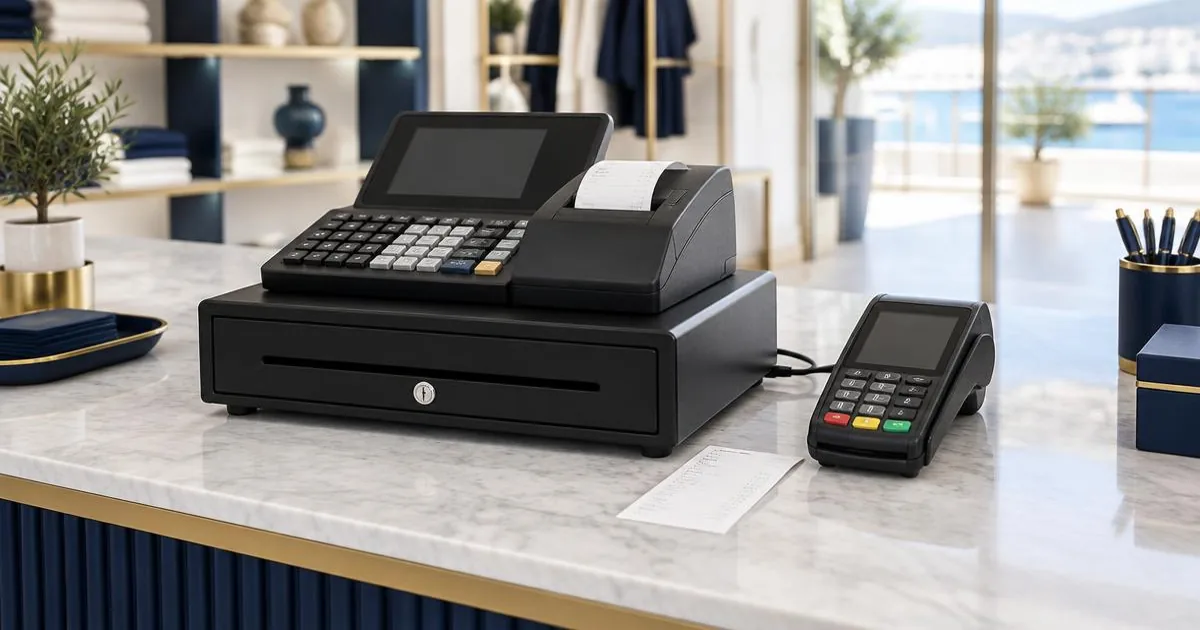
If your business accepts card payments and issues retail receipts, the POS terminal and cash register can no longer operate as two independent devices. Legislation requires their interconnection, and AADE systematically checks whether this has been completed, imposing fines reaching tens of thousands of euros. In this article, NSTAX explains in detail which businesses the obligation applies to, how it works in practice and how you can avoid a fine that, in most cases, is easy to prevent.
If you are reopening after winter, consult the seasonal businesses checklist before the first day of operation.
What Is a Fiscal Electronic Mechanism and What Does Interconnection Mean?
The Fiscal Electronic Mechanism (FIM) is the cash register or equivalent retail receipt issuing system used by the business. Interconnection means that the POS terminal communicates directly with the FIM, so the amount charged to the customer's card matches the amount on the receipt issued. This prevents a card charge without a corresponding fiscal receipt, limiting tax evasion and also protecting the business itself from errors.
Which Businesses Must Interconnect Their Systems?
Interconnection is mandatory for retail transactions of businesses that are required to use a FIM or that use one even though they were not required to do so. In practice, this concerns retail shops, food service businesses, consumer services and any business accepting card payments from individual customers. The deadline for initial interconnection has already passed, so the obligation is fully in force and also applies from the first day of operation to new or seasonal businesses.
When Is Interconnection Not Required?
The obligation does not apply in every case. For example:
- A business conducting exclusively wholesale transactions is not required to interconnect its POS terminals with a cash register system
- When a business carries out transactions for which a FIM is not mandatory and does not actually use a FIM, interconnection is not required for those transactions
Because the exemption depends on the type of transactions and their documentation, each case should be checked individually before assuming that it does not apply to you.
Multiple POS Terminals and Cash Registers: How Interconnection Works
If a business has more than one POS terminal or more than one FIM, the following rules apply:
- All POS terminals must be interconnected with one or more of the business's FIMs
- Not every FIM must be connected to a POS terminal; a FIM that is not connected to a POS may be used exclusively for cash transactions
- More than one POS terminal may be connected to a single FIM
Fines for Failure to Interconnect
Significant fines apply to businesses that fail to interconnect their POS terminals with the FIM:
- €10,000 if the business uses a single-entry accounting system
- €20,000 if the business uses a double-entry accounting system
- The fines are halved for businesses in small settlements and on small islands, subject to the conditions set out in law
- For a repeat violation within five years, the fine is doubled, and for each subsequent identical violation it is tripled
In addition, the Tax Procedure Code provides for separate fines for failure to issue or inaccurate issuance of fiscal documents, which may be added following an audit.
What AADE Checks
AADE cross-checks POS terminal records against cash register data to identify businesses accepting card payments without issuing the corresponding receipt or that have not interconnected their systems. In publicly reported cases, fines of €10,000 and €20,000 have been imposed on businesses that failed to interconnect their terminals in time. Another frequently overlooked point: suspension of POS operation by the provider because of an unpaid invoice does not remove the interconnection obligation.
A Practical Example
Suppose a coffee and snack shop, operating as a sole trader with single-entry books, has one cash register and two POS terminals, one at the counter and one for table service. The owner has interconnected only the counter POS, believing that the second is rarely used.
During an audit, AADE identifies that the second terminal is not interconnected with the FIM. Because the obligation concerns all POS terminals, not just the main one, the business faces a €10,000 fine, an amount that may exceed its monthly profit. If the same business kept double-entry books, the corresponding fine would be €20,000. The solution was simple and inexpensive: connecting the second POS to the same cash register, something explicitly permitted by the rules.
By contrast, a business selling exclusively wholesale to other businesses would not be required to interconnect, which is why correctly assessing the type of transactions is the first step.
The Most Common Mistakes
- Interconnecting only the main POS while the business's other devices remain unconnected
- Using portable or secondary POS terminals for off-site sales without interconnection with a FIM
- Assuming that POS suspension because of an unpaid invoice solves the problem
- Failing to interconnect a new or seasonal business reopening after a period of closure
- Confusing retail and wholesale transactions, leading to the mistaken belief that no obligation applies
- Buying a new POS from a provider without checking that it supports interconnection with the business's FIM
5 Practical Compliance Tips
- List all your business's POS terminals, both fixed and portable, and check that each is interconnected with a FIM.
- Before changing or adding a POS terminal, confirm with the provider and the cash register technician that interconnection will be completed before use.
- If your business is seasonal, check interconnection before reopening, not after the first card payment.
- Do not leave POS provider invoices unpaid, because service suspension does not exempt you from the obligation.
- Ask your accountant for a brief compliance review, especially if you have more than one device.
Frequently Asked Questions
Which businesses must connect their POS to the cash register?
If I sell only wholesale, do I need to interconnect my POS?
Can I connect more than one POS to a single cash register?
What is the fine for failure to interconnect?
What happens if the POS provider suspends service because of an unpaid invoice?
Are You Sure Your Business's POS Terminals Are Compliant?
NSTAX, an accounting and tax advisory firm in Athens, reviews your business's compliance with FIM and POS obligations and guides you in avoiding fines. Contact us for a brief review.
Also read our guide to myDATA and electronic invoicing, e-shop tax obligations and explore NSTAX services for businesses.
Interconnection obligations and fines are based on the current framework and AADE clarifications and may change. The example is illustrative. Contact us for an accurate assessment of your own business.